

Why Outdoor Learning Matters More Than Ever for Canadian Children
Discover why outdoor learning is essential for Canadian children’s development,
backed by research on mental health, physical activity, and academic success.

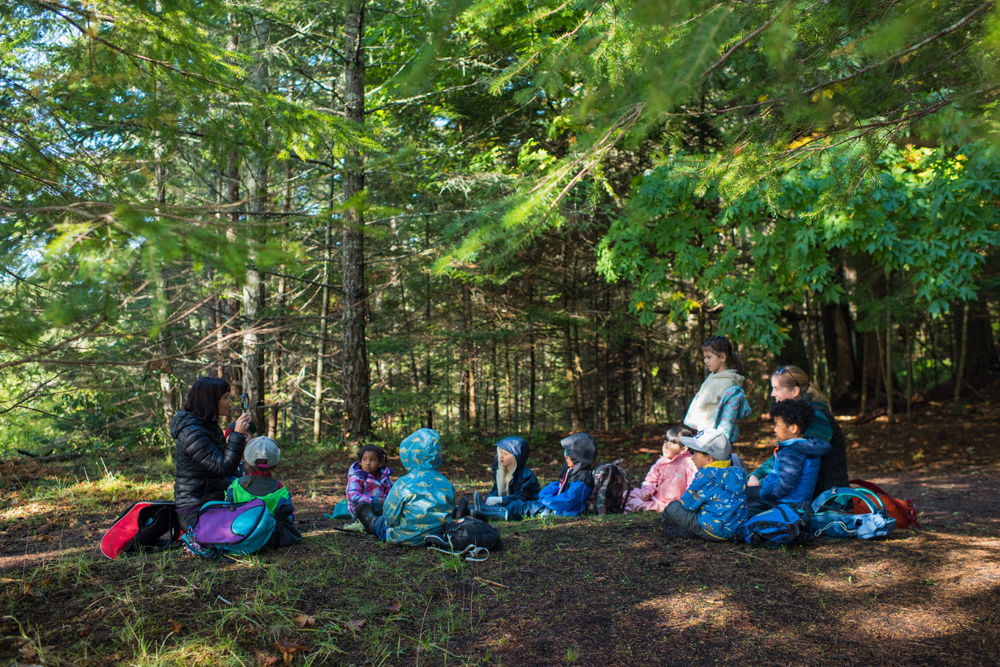
Your child comes home from school mud-splattered and energized, talking excitedly about the salamander they found under a log. They’re exhausted in the best way, having spent the afternoon building shelters in the forest, measuring tree circumference for mathematics, and observing spring changes for science.
Meanwhile, across Canada, most children spend their school days entirely indoors, sitting at desks, staring at screens, moving only during brief recess breaks that are frequently cancelled due to weather. Only 39% of Canadian children and youth meet the recommendation of 60 minutes daily moderate-to-vigorous physical activity, according to ParticipACTION’s 2024 Report Card. Screen time has become the default, with just 27% meeting the guideline of less than two hours of recreational screen time per day.
The disconnect between children and nature isn’t just about missed playtime. It’s about fundamental developmental needs going unmet during critical years. Research from Canadian universities and education systems reveals that outdoor learning provides measurable benefits across cognitive, physical, psychological, and social domains. Yet as climate change creates new barriers to outdoor time and screen-based activities increasingly dominate children’s lives, the gap between what children need and what they’re experiencing continues widening.
Here’s what Victoria parents should understand about outdoor learning, why it matters for children’s development, and how progressive schools integrate nature connection into education rather than treating it as optional enrichment.
The Canadian research on outdoor learning benefits
Interest in outdoor education has grown across Canada, particularly since COVID-19 when open-air environments reduced disease transmission risks. But the benefits extend far beyond pandemic considerations. Canadian researchers have documented multiple advantages of outdoor learning environments for children’s development.
A comprehensive study of Quebec teachers during the 2020-21 school year surveyed 1,008 participants, finding that 578 teachers practiced outdoor education across kindergarten through Grade 11. Among these, 432 taught kindergarten through Grade 6, with 146 teaching Grades 7-11. The three main intentions teachers shared for leading outdoor education were connecting children to nature, using real-life contexts for learning, and benefiting from larger learning spaces.
Research shows that outdoor education has potential to improve how children retain learning and increase students’ ability to transfer their learning to everyday situations. Even brief contact with nature can have positive effects on cognitive performance. At the physical level, outdoor education reduces sedentary behaviour while health research shows contact with nature reduces blood pressure and risks associated with myopia.
Canadian Forest School educators reported benefits including improved self-confidence, social and physical skills, creativity, and increased nature appreciation among children. A systematic review of 13 studies of school-based outdoor education programs revealed benefits across social, health, and learning domains.
The social and emotional development benefits particularly stand out. When 36 Canadian primary school educators who implemented outdoor learning were interviewed through focus groups, most themes generated related to students’ social and emotional development. Educators perceived the emergent, unstructured nature of outdoor learning as driving these benefits, suggesting that educators can leverage outdoor learning contexts to help integrate social-emotional learning more deeply into teaching practice.
One educator observed that when children play outside or outdoors, their bodies physically relax, noting how rich the outdoor learning experience is and how it drives what students are doing. The whole-body nature of outdoor learning creates engagement that’s difficult to replicate in traditional classroom settings.
Mental health benefits are particularly significant. Research examining outdoor physical activity among Canadian adolescents found that those spending 14 or more hours per week being active outdoors had the highest prevalence of positive mental health, life satisfaction, and happiness. While 14 hours isn’t a magic number, aiming for this amount each week (equivalent to 2 hours daily) appears to be a sensible target given all the potential benefits and low risk involved.
What’s happening with Canadian children and nature
The statistics paint a concerning picture. According to the 2024 ParticipACTION Report Card on Physical Activity for Children and Youth, Canadian children and youth received a D+ grade for overall physical activity, up from D in 2022 but still indicating only 39% meet recommended activity levels.
The decline has been particularly sharp among teenagers. Between 2018-2019 and 2022-2024, the percentage of youth aged 12-17 meeting physical activity recommendations dropped from 36% to just 21%, a 15-percentage-point decline representing the only age group to show significant decreases. Breaking this down by gender reveals even starker patterns: boys aged 12-17 dropped from 50% to 33% meeting recommendations, while girls aged 12-17 plummeted from 21% to just 8%.
Screen time has replaced outdoor time for many Canadian children. Prior to the pandemic, 41% of Canadian youth aged 12-17 spent less than two hours daily on screens on school days, with only 21% spending more than four hours. By 2021, only 27% were spending less than two hours daily on screens while 34% spent more than four hours on screens even on school days.
For younger children, the pattern continues. The percentage of children aged 5-11 meeting screen time recommendations dropped from 73% in 2018-2019 to 62% in 2022-2024. Prior to the pandemic, 46% of 5-11-year-old children were active for at least 60 minutes daily. That fell to just 18% by October 2020.
The broader Canadian context reveals even more troubling trends. Nearly two-thirds of Canadians spend less than two hours outside in a typical week, according to the 2017 Coleman Canada Outdoor Report. This lack of time outside contributes to what researchers call Nature Deficit Disorder, which contributes to poor concentration, anxiety, obesity, and weakened ecological literacy and environmental stewardship.
When children are exposed to nature, even in simple ways or small increments, intrigue and interest soon follow. The challenge is creating opportunities for that exposure when cultural patterns, school structures, and climate realities conspire to keep children indoors.
Climate change as a new barrier to outdoor learning
The 2024 ParticipACTION Report Card highlighted a emerging threat to children’s physical activity and outdoor time: climate change. Environmental indicators show that the number of annual weather alerts in Canada has more than doubled in the past 10 years. Unfavourable weather and climate conditions such as heatwaves, heavy rain, and poor air quality have potential to increase time spent indoors being sedentary.
Dr. Mark Tremblay, Chief Scientific Officer for the ParticipACTION Report Card and Senior Scientist at the CHEO Research Institute, noted that the effects of climate change could be particularly harmful for kids as they face special risks from air pollution and extreme heat. Smoke-filled air from wildfires, intense heat warnings, and severe weather events lead to cancelled recesses and outdoor sport and recreation activities, pushing children indoors with increased exposure to screens.
This creates a vicious cycle. Children spend less time outdoors and in nature, reducing their direct experience with and understanding of environmental systems. This weakened ecological literacy and connection makes environmental stewardship less personally meaningful. Meanwhile, the climate impacts that keep children indoors continue accelerating, further limiting outdoor opportunities.
In British Columbia specifically, with our proximity to forests and coastlines, climate-related smoke and extreme weather events increasingly disrupt outdoor activities. Victoria families experienced this directly during recent wildfire seasons when air quality alerts kept children inside for days at a time.
The challenge for schools becomes how to maintain outdoor learning commitments even when climate realities create obstacles. The answer isn’t abandoning outdoor education during difficult weather but rather building resilience through year-round nature connection so children develop both the capacity and the desire to engage with outdoor environments in all seasons and conditions.
The developmental case for nature connection
Beyond statistics about activity levels and screen time, there’s a fundamental developmental argument for outdoor learning. The biophilia hypothesis, proposed separately by psychological theorist Erich Fromm and biologist E.O. Wilson, suggests humans innately need strong relationships with nature. Wilson defined it as our innate tendency to focus upon life and lifelike forms and, in some instances, to affiliate with them emotionally.
Researchers examining this hypothesis have pulled together extensive evidence documenting that frequent exposure to nature is essential for a child’s mental, psychological, and physical development, whether mental acuity, creativity, or other capacities. One educator and researcher with forty years of program design, research, and teaching in the outdoors stated that one transcendent experience in nature is worth a thousand nature facts.
The mission for educators becomes providing experiences in natural areas that embody these characteristics. For some children, the nearby natural area is a forest, but for others it may be a ditch, backyard, or overgrown vacant lot where they can explore and experience other forms of life. The ecological quality of the setting is not the key but rather the opportunity to experience semi-wild settings.
The benefits of allowing children to play with “loose parts” are widely recognized in preschool settings, yet there are no better loose parts than pinecones on the forest floor, leaves in a pile, or pebbles in a stream. The level of structure may vary with children and context, but there needs to be a clear sense of purpose to activities, whether strengthening feelings (appreciating the beauty of a place), building ecological understandings, or developing action competencies.
Meaningful environmental education in the outdoors needs to be a holistic process focusing on the feelings (the heart), the understandings (the head), and the actions (the hands). This integrated and holistic learning approach aligns with extensive research documenting benefits across many spheres. Our personal identity is made up of a constellation of factors giving us sense of self, rooted in deeply held values and played out in our feelings, thoughts, and actions.
How outdoor learning looks in practice on our campus
Our 143-acre campus backing onto provincial land provides extraordinary opportunities for outdoor learning that few schools can match. But what matters isn’t the size of our natural space — it’s how we use it. Outdoor learning isn’t simply moving indoor activities outside. It’s fundamentally different pedagogy that leverages natural environments’ unique characteristics.
In our Early Years program, children spend extensive time outdoors in all weather, embodying the principle that there is no bad weather, just inappropriate clothing. Young children build gross motor skills through climbing, balancing, running on varied terrain. They develop sensory awareness through tactile and auditory experiences impossible to replicate indoors. They observe seasonal changes directly, watching buds appear on branches they climbed weeks earlier, tracking where water flows after rain, noticing which birds return in spring.
The prepared environment extends outdoors where children pursue their interests using natural loose parts. They build structures with fallen branches, create art with mud and leaves, sort objects by characteristics they determine, measure and compare natural items, develop theories about why things work the way they do in nature, and test those theories through exploration and experimentation.
Elementary and middle school students tackle projects integrating outdoor learning with academic content. When studying ecosystems, they don’t just read about food chains and energy transfer — they observe them in our forest, identifying producers, consumers, and decomposers in our actual environment. When learning about water cycles, they trace water’s path across our property, seeing how it moves from sky to soil to plants to atmosphere.
Mathematics happens outdoors through measuring tree circumference and calculating diameter, estimating and verifying volumes in natural containers, identifying geometric patterns in nature, collecting and analyzing data about seasonal changes, and using natural features to understand spatial relationships and scale. These aren’t disconnected activities but integrated learning experiences where mathematical thinking serves authentic purposes.
Our High School students’ project-based learning frequently centers on outdoor contexts. A sustainable agriculture project requires extensive time observing and working with natural systems, understanding soil health, plant relationships, weather impacts, and ecological balance. Building alternative energy systems demands understanding of how natural forces (wind, sun, water) can be harnessed, requiring students to spend time analyzing site characteristics and environmental conditions.
The outdoor immersion experiences punctuating our eight-week cycles take students into wilderness environments for extended periods. These aren’t nature field trips where students observe from a distance. They’re immersive experiences where students engage directly with natural environments, developing competence and confidence through challenge and achievement, building appreciation for wild spaces through extended contact, and understanding their own capacity for resilience and adaptation.
The social-emotional benefits progressive schools recognize
Research consistently shows that outdoor learning particularly benefits social-emotional development. Canadian educators implementing outdoor learning reported that being in outdoor contexts helped reduce sensory overload, allowing students’ bodies to relax. The fresh air, space, and freedom to express feelings create conditions supporting emotional regulation.
The emergent, unstructured nature of outdoor learning drives many benefits. When students aren’t following predetermined scripts but instead responding to what they discover in nature, they develop genuine agency. They make real decisions with real consequences. They experience authentic cause and effect. They learn to assess risk, manage uncertainty, and adapt to changing conditions.
Natural environments inherently require cooperation and collaboration. Building a shelter needs multiple people working together. Navigating challenging terrain means supporting each other. Solving problems that arise in outdoor contexts often requires collective effort and negotiation. Students develop interpersonal skills through genuine need rather than artificial team-building exercises.
The mixed-age dynamic in our classrooms enhances these social-emotional benefits in outdoor contexts. Older students model competence and safety awareness for younger ones. Younger students observe and learn from watching skilled peers navigate challenges. Everyone contributes based on their current capabilities while stretching toward new competencies. The outdoor environment provides endless opportunities for mentorship and leadership development.
Children also develop emotional connections to place through regular outdoor experiences. They notice when their favourite climbing tree starts budding. They remember where they found interesting insects. They have stories about adventures in specific locations. This sense of place and belonging in natural spaces builds the foundation for environmental stewardship and provides emotional grounding that serves them throughout life.
Research examining outdoor learning’s impact on mental health and well-being found improvements in self-awareness, emotional intelligence, and communication. Students who spent time learning outdoors showed reduced anxiety, better mood regulation, and increased resilience. These aren’t small benefits. They’re fundamental capacities affecting every aspect of children’s lives.
What parents should look for in schools
Not all outdoor learning is created equal. Twenty rocks in rows does not produce good education in nature, as one Canadian researcher noted. When evaluating schools’ outdoor learning approaches, certain qualities distinguish meaningful programs from tokenistic nature time.
Look for regular, sustained outdoor experiences rather than occasional field trips. Outdoor learning should be integrated into weekly or daily routines, not treated as special events. Ask how much time students spend outdoors across seasons and weather conditions. Schools committed to outdoor learning maintain their practice year-round, adjusting activities to conditions rather than abandoning outdoor time when weather is less than perfect.
Examine whether outdoor time serves genuine learning purposes or simply provides a break from “real” learning. Quality programs integrate outdoor experiences with academic content, skill development, and inquiry-based learning. The outdoor environment should be a context where students investigate questions, solve problems, and develop understanding rather than just a place to play before returning to actual instruction.
Ask about teacher preparation and confidence with outdoor learning. Educators need specific training to effectively facilitate outdoor learning experiences. They should understand how to leverage natural environments for learning, how to manage safety while allowing appropriate risk, and how to guide inquiry and exploration without over-directing student experiences.
Consider the school’s natural spaces and how they’re used. Large wilderness areas are wonderful but not necessary. Well-designed school grounds with diverse features, nearby natural areas students can access regularly, and creative use of available outdoor spaces demonstrate commitment to outdoor learning regardless of campus size.
Evaluate whether outdoor learning connects to the school’s broader educational philosophy. In our case, outdoor learning aligns perfectly with Montessori principles around self-directed exploration, hands-on learning with concrete materials (what’s more concrete than nature?), development of independence and competence, and integration of subject areas through purposeful work. The outdoor environment extends our prepared environment rather than existing separately from it.
Look for evidence that outdoor learning supports all students, including those with varying physical abilities, sensory sensitivities, or learning differences. Inclusive outdoor programs provide multiple ways to engage, offering both structured and unstructured opportunities, supporting students who need additional guidance while allowing independence for those who thrive with freedom, and ensuring that outdoor experiences build confidence rather than creating anxiety or exclusion.
The case for outdoor learning isn’t about nostalgia for simpler times or romanticizing nature. It’s about fundamental human development needs that remain constant even as our world changes. Children need to move, to explore, to encounter challenge and uncertainty, to experience direct cause and effect, to develop competence through genuine achievement.
They need connection to something larger than screens and scheduled activities. They need to understand themselves as part of natural systems, not separate from or superior to the living world. They need to develop ecological literacy and environmental connection that will shape how they engage with the planet’s future.
The research from across Canada demonstrates measurably better outcomes for children who engage regularly in outdoor learning: improved physical health and fitness, stronger mental health and emotional regulation, enhanced social skills and collaboration, better academic performance and knowledge retention, increased environmental awareness and stewardship, and greater resilience and capacity to handle challenges.
These aren’t minor advantages. They’re capacities that affect every aspect of children’s current and future lives. And they’re capacities that require nature connection to fully develop. No amount of screen time, no indoor curriculum, no virtual montage of outdoor experiences can substitute for direct, regular, meaningful engagement with natural environments.
On our 143-acre campus in Metchosin, with forests to explore, fields to run through, and provincial land extending beyond our boundaries, we recognize outdoor learning not as a luxury or enhancement but as essential to education. Every season, every weather condition, every age provides opportunities for students to learn in, about, and for nature.
Experience outdoor learning in action on our campus. Schedule a tour to see how we integrate nature connection throughout our program across all ages.