

What No One Tells You About Kindergarten Readiness
The kindergarten readiness checklist going around parent groups lists 27 items.
Here’s what Canadian developmental researchers actually say matters most for kindergarten success.

The kindergarten readiness checklist going around parent groups lists 27 items. Can your child count to 20? Hold a pencil correctly? Sit still for ten minutes and follow a two-step instruction? Write their first name? Recognize the letters of the alphabet?
Here’s what Canadian developmental researchers actually say matters most for kindergarten success — and it’s almost none of those things.
Every spring, families with four- and five-year-olds face a version of the same anxiety. Registration windows open. Decisions feel permanent. The noise online is loud and often contradictory. We’ve been working with young children and their families for 67 years, and we can tell you that the questions parents are asking in May — “Is she ready?” “Is he behind?” — are almost always the wrong questions. The right questions sound different. And the research behind them changes everything about how you think about early learning.
Why the Academic Checklist Misses the Point
The checklist approach to kindergarten readiness isn’t wrong because early literacy and numeracy don’t matter. They do, eventually. It’s wrong because it mistakes the outputs of healthy development for the inputs that produce it. A child who can count to 20 has learned to count to 20. A child who has developed genuine self-regulation, social competence, and emotional maturity will keep learning — independently, joyfully, and for life.
The checklist also creates a particular kind of parent anxiety that is, ironically, counterproductive. When the focus becomes drilling letters and numbers in the months before school begins, the experiences most likely to actually prepare a child — unstructured outdoor play, rich conversation, collaborative pretend play, resolving small conflicts with siblings — get squeezed out. We rush children toward outputs and quietly undermine the developmental conditions that make those outputs possible.
This isn’t a criticism of the parents sharing these lists. The anxiety is real, and it comes from a genuine place of care. But the frame needs to shift. And the data is clear about where to look.
What Canadian Research Says Kindergarten Children Actually Need
For more than two decades, the Human Early Learning Partnership (HELP) at the University of British Columbia has been tracking the developmental health of BC kindergarten children using the Early Development Instrument (EDI) — a research tool completed by kindergarten teachers for every child in their class. The EDI doesn’t measure whether children can write their name or recite the alphabet. It measures five domains of early child development that researchers have identified as the most reliable predictors of how children will fare in school and throughout their lives: Physical Health and Well-being, Social Competence, Emotional Maturity, Language and Cognitive Development, and Communication Skills and General Knowledge.
The most recent HELP data, which covers Wave 9 of EDI collection (from 2022 onward), follows on a Wave 8 finding that revealed 32.9% of BC kindergarten children were arriving at school vulnerable in one or more of those five domains. A subsequent HELP report found that number had climbed to 35.8% — the highest provincial vulnerability rate ever recorded in BC. That means more than one in three children entering kindergarten in this province are starting school with developmental challenges in areas that research consistently links to long-term outcomes in school success, mental health, and overall well-being.
Two of those five EDI domains carry the highest vulnerability rates, and they have for multiple consecutive waves: Emotional Maturity and Social Competence. Not letter recognition. Not number sense. The capacity to manage frustration, persist through challenge, cooperate with peers, and navigate the social world of a classroom.
This is striking, and it’s not a coincidence. It reflects what developmental science has been telling us for years: the skills that enable a child to actually learn in a school environment are fundamentally social and emotional in nature. And they develop not through worksheets, but through the kinds of experiences that are increasingly harder to find in overscheduled, screen-saturated early childhoods.
You can read HELP’s full EDI data and provincial summaries at earlylearning.ubc.ca.
The Self-Regulation Advantage
Self-regulation is one of the most researched and most misunderstood concepts in early childhood development. It doesn’t mean sitting still. It doesn’t mean being quiet or obedient. Self-regulation is the capacity to manage one’s own attention, emotions, and behaviour in a way that allows for learning and positive social interaction — and it develops gradually, with enormous variability, across the early years.
For a four-year-old, self-regulation looks like being able to transition from a preferred activity to a less preferred one without complete dysregulation. For a five-year-old, it looks like sustaining focus on a task that isn’t immediately rewarding. For a six-year-old, it begins to look like noticing frustration and choosing a response rather than being overtaken by it.
The Centre of Excellence for Early Childhood Development, based in Montreal, publishes a comprehensive, peer-reviewed Encyclopedia on Early Childhood Development that draws on researchers from across Canada and internationally. Their synthesis of self-regulation research is unequivocal: self-regulatory skills in the early years are among the strongest predictors of academic achievement, positive peer relationships, and mental health outcomes across childhood and adolescence. Children who arrive at kindergarten with stronger self-regulatory capacity learn more, engage more, and adapt more readily to the demands of a school environment — regardless of their pre-academic knowledge. You can explore their published research summaries at child-encyclopedia.com.
The practical implication is significant. If you want to prepare your child for kindergarten success, the most valuable thing you can do is not drill phonics. It’s to give them environments and relationships that build self-regulatory capacity: consistent routines, warm responsive adults, opportunities to make choices and experience the consequences, unstructured time to play and resolve conflicts, and — critically — space to struggle and recover without immediate rescue.
Social-Emotional Skills
There’s a phrase in early childhood education that we come back to again and again: you can’t think your way into learning if you don’t feel safe enough to try. A child who is emotionally dysregulated, socially isolated, or anxious in their school environment cannot access the cognitive resources that academic learning requires. The emotional and social dimensions of school readiness aren’t separate from academic readiness — they’re the precondition for it.
BC’s Early Learning Framework, revised in 2019 by the Ministry of Education in collaboration with early childhood educators, researchers, Indigenous organizations, and communities across the province, centres this understanding explicitly. The Framework guides early learning environments for children from birth to age eight across all settings — child care, preschool, StrongStart programs, and primary classrooms — and its foundational vision is built around three interconnected ideas: belonging, well-being, and engagement. Not letter sounds. Not number lines.
The Framework describes belonging as “living and learning judgement-free” — the experience of being fully included, seen, and valued in a learning community. It positions well-being not as an add-on to education but as a prerequisite for it. And it frames engagement not as compliance with instruction, but as the natural expression of a child’s curiosity and sense of agency in their environment.
This is the theoretical and policy foundation of what good early learning actually looks like in BC. And it aligns precisely with what the EDI data is telling us about what children need when they arrive at school.
What a High-Quality Early Learning Environment Actually Looks Like
Knowing what children need is one thing. Understanding what kind of learning environment actually builds those capacities is another.
Research on early childhood education consistently points to a set of environmental conditions that support social-emotional development, self-regulation, and a genuine love of learning. These aren’t luxuries or philosophical preferences — they’re the structural features that allow young children to develop the capacities the EDI and the BC Early Learning Framework identify as foundational.
Low adult-to-child ratios matter not because teachers need fewer children to manage, but because genuine relationships between adults and children are the mechanism through which self-regulation, emotional maturity, and social competence develop. Children learn to regulate by being co-regulated — by experiencing, repeatedly, what it feels like to be held in a calm, responsive relationship when things get hard. That only happens when adults have enough time and attention to actually be present with individual children.
Child-led exploration matters because intrinsic motivation — the internal drive that makes learning self-sustaining — develops through experiences of choice and agency. When children can pursue what they’re genuinely curious about, they encounter the natural challenges, frustrations, and satisfactions that build persistence, problem-solving, and the conviction that their ideas matter.
Multi-age peer communities matter because mixed-age groupings create the social complexity that builds genuine competence. Younger children learn from older ones; older children develop empathy, patience, and leadership by caring for younger ones. This is fundamentally different from the age-sorted social experience of conventional classrooms, and the developmental benefits are well-documented.
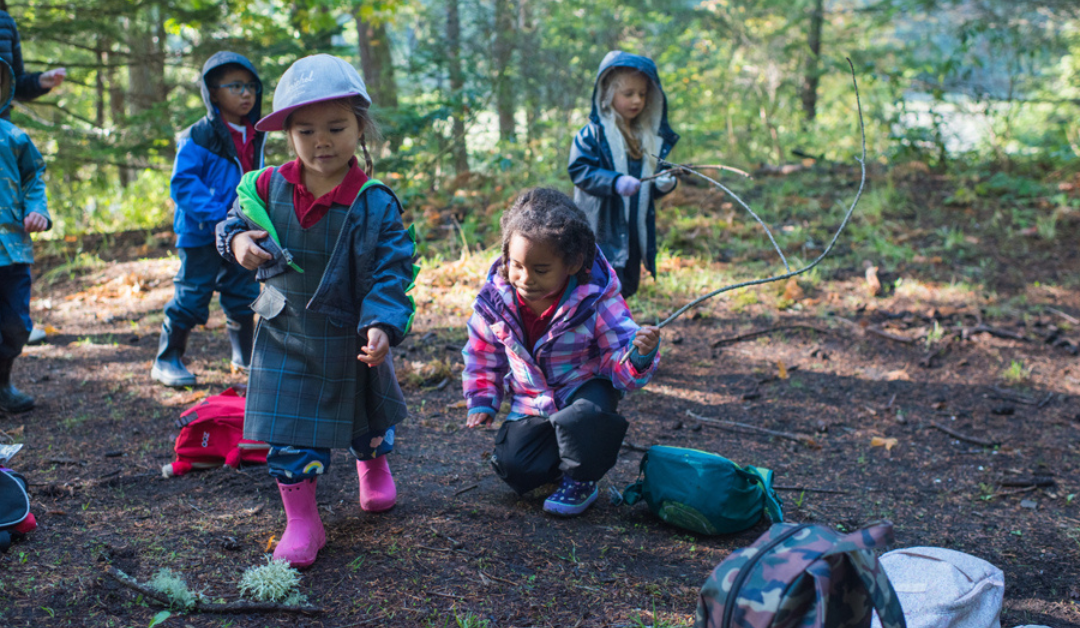
Outdoor and nature-based learning matters because movement, sensory experience, and time in natural environments are not ancillary to early childhood development — they are deeply integrated with it. Children’s capacity for sustained attention, emotional regulation, and creative thinking is consistently supported by access to unstructured outdoor time.
At Westmont, our Early Learning program is built around all of these conditions. Our campus backs onto 143 acres of natural land — it is not a backdrop for learning, it is a learning environment in itself. Our classrooms are calm, carefully prepared spaces where children move freely, choose their work, and engage deeply with materials designed to meet them at their developmental level. Our multi-age groupings allow children to be both learners and teachers. And our educators are trained to observe, to follow the child’s lead, and to support development rather than direct it.
We are not teaching children to perform readiness. We are building the foundations from which readiness grows naturally.
Questions to Ask When Evaluating Early Learning Programs in Victoria
If you’re visiting early learning programs this spring, we’d encourage you to come with a different set of questions than the one circulating in parent Facebook groups. Not “What does literacy instruction look like?” — though that matters too, eventually. But:
What does a typical day actually look like, from arrival to dismissal? Are children moving freely, or seated at tables?
How do educators respond when a child is upset, dysregulated, or in conflict with a peer? Is the response co-regulating and relational, or is it primarily corrective?
Is outdoor time structured activity, or is there genuine unstructured time for exploration and child-led play?
How do educators communicate with families — and does it feel like partnership, or like reporting?
What does the environment itself communicate? Does it feel calm and purposeful, or busy and stimulating in a way that competes for children’s attention?
Are there children of more than one age in the same space? And if so, how do the relationships between them look?
These questions won’t be on the tour agenda. But the answers will tell you far more about a program’s capacity to support your child’s development than any checklist of academic benchmarks.
How to Know When Your Child Is Ready
Here is what we’d most like parents to hear: readiness is not a fixed threshold your child either reaches or doesn’t. It is a developmental process, and a good early learning environment is designed to meet children exactly where they are in that process.
The anxiety about whether your four- or five-year-old is “ready” is understandable. It comes from love, and from a world that tends to frame early education as preparation for subsequent education — as though kindergarten exists to get children ready for Grade 1, which exists to get them ready for Grade 2, in an endless chain of preparation that leaves out the actual experience of being a child right now.
The most recent HELP data shows that the two EDI domains with persistently high vulnerability rates in BC are Emotional Maturity and Social Competence — and these are exactly the domains that a quality early learning environment is designed to support. Not by teaching children to feel emotions on schedule, but by giving them the relationships, the time, and the environment in which those capacities can develop at their own pace.
What readiness actually looks like is a child who has been given enough belonging, enough well-being, and enough genuine engagement that their natural curiosity is intact. A child who still wants to know things. A child who can recover from frustration, even if imperfectly. A child who knows that the adults in their life are safe to go to when things get hard.
If you’ve given your child that — if those things are true — they are ready. The right program will take it from there.
See how our Early Learning program builds the foundations that matter most. Schedule a campus tour to visit our early childhood classrooms and experience the difference for yourself.