

What Strong Elementary Schools Actually Look Like
Fraser Institute rankings don’t tell you what matters.
Canadian research reveals what actually makes elementary schools effective for children ages 5-11.

The Fraser Institute taps into genuine parental concern about education quality. But the methodology measures a narrow slice of what actually matters for children ages five through eleven. Academic performance on standardized tests — specifically Foundation Skills Assessment results — tells you something about a school. What it doesn’t tell you is whether that school develops curious, confident, engaged learners who love learning.
Canadian education researchers and policy analysts have documented serious limitations with ranking-based school evaluation. The Canadian Centre for Policy Alternatives (CCPA) notes that Fraser Institute rankings focus only on exam results, which is destructive of many efforts underway to really improve and understand schools. Rankings don’t help parents make informed choices about programs and philosophy. They reduce complex educational environments to single numbers.
Here’s what Canadian research actually says about effective elementary education — and what to look for when choosing schools for children in Grades 1 through 6.
Why school rankings don’t tell you what you actually need to know
The Fraser Institute rankings compile standardized test scores, demographic data, and other metrics into single numerical scores. Schools receive ratings out of 10. Parents compare these numbers assuming higher scores mean better education.
Several fundamental problems exist with this approach. First, rankings measure what’s easily quantifiable rather than what’s educationally important. Standardized test performance tells you very little about critical thinking development, creativity, collaboration capacity, emotional regulation, intrinsic motivation, or dozens of other factors that predict long-term success.
Second, rankings don’t account for context. Socioeconomic factors heavily influence standardized test performance. Schools serving higher-income neighborhoods typically score higher because students arrive with resources their families can afford. An investigation revealed that merely 45% of an elementary school’s rank derived from provincial assessments, with the majority from measures correlating strongly with socioeconomic status.
Third, focusing exclusively on test scores incentivizes teaching to tests. Schools maximizing test performance sometimes narrow curriculum and reduce time on non-assessed subjects. Students may score well while missing crucial development in creativity, inquiry, and collaboration.
Fourth, rankings tell you nothing about program philosophy, teaching approach, learning environment, community culture, or how students experience school daily. These factors matter enormously but don’t appear in numerical scores.
What Canadian research says about effective elementary education
When researchers study what actually supports children’s learning and development during elementary years, different factors emerge than those emphasized in rankings.
Low student-to-teacher ratios consistently appear in research as important determinants of elementary student outcomes. Extensive academic literature strongly supports the common-sense notion that class size matters for young learners.
Research from Ontario examining class size reduction between 2003 and 2008 found that nearly three-quarters of primary teachers reported quality of their relationships with students improved as a result of smaller classes. Two-thirds said their students were more engaged in learning than before class size reduction. Many parents of children enrolled in smaller classes reported that their children appeared to be learning more and were more comfortable at school.
Canadian studies examining elementary education find that smaller classes improve student behavior and peer relationships, increase student engagement in early grades, contribute to alleviating antisocial and aggressive behavior, allow teachers to work individually with students and meet their diverse needs, and support building stronger teacher-student relationships that predict long-term engagement.
The relationship quality between teachers and individual students matters enormously for elementary-aged children. When class sizes allow teachers to know each student well, notice when they’re struggling, provide individualized support, and build genuine connections, students develop confidence as learners and stronger academic outcomes follow.
Research indicates that class size benefits are particularly pronounced in early elementary years. Students in classes with fewer than 20 students in Grades K through 3 benefit greatly from the smaller enrollment. The advantages compound over time — students who remain in small elementary classes for five or six years show roughly 10-point advantages over those in large classes by sixth grade, equivalent to 4.5 months of additional learning.
Beyond class size, Canadian research identifies other factors supporting effective elementary education. Individualized pacing allows students to progress at rates matching their actual development rather than arbitrary grade-level expectations. Social-emotional learning integrated throughout the day supports the emotional regulation and interpersonal skills foundational for both learning and life. Intrinsic motivation developed through engaging, meaningful work produces stronger long-term outcomes than extrinsic rewards systems. Multi-age classrooms grouping students across two or three grade levels allow students to progress at individual paces while experiencing both learning from older peers and mentoring younger students.
The low-ratio advantage: why class size matters more than parents think
The connection between class size and learning outcomes operates through several mechanisms that matter especially for elementary-aged children.
Individual attention increases dramatically in smaller classes. A teacher with 15 students can spend twice as much one-on-one time with each child compared to a teacher with 30 students. This matters for diagnosing learning gaps, providing targeted support, and building relationships that help children feel known and valued.
Behavior management consumes less time in smaller classes, freeing time for actual instruction. Teachers spend less energy managing disruption and more time teaching. The learning environment stays calmer, which particularly benefits students who struggle with sensory processing or attention regulation.
Participation opportunities multiply in smaller groups. Each child gets more chances to speak, contribute ideas, ask questions, and receive feedback. Quiet students don’t disappear. Active students don’t dominate.
Teachers can differentiate instruction more effectively when working with fewer students, creating small learning groups based on actual needs, adjusting pacing for different learners, and modifying approaches when students aren’t understanding.
Relationships develop more deeply when teachers work with fewer students. Elementary children thrive when they feel known by their teachers. They’re more willing to take learning risks, ask for help, and engage with challenging material when they trust the adult supporting them.
Individualized pacing: what it means in practice
Traditional elementary schools group students by age into grades, then teach grade-level curriculum to all students regardless of individual development. This creates inevitable mismatches. Some students aren’t yet ready for grade-level material. Others already mastered it and need greater challenge.
Individualized pacing means students progress through material based on their actual readiness rather than age-based expectations. In practice, this looks like students working at different levels in different subject areas based on where they actually are, not where arbitrary timelines say they should be.
A third-grade student might work at fifth-grade level in mathematics because they grasp mathematical concepts quickly, while working at second-grade level in writing because fine motor development came more slowly. There’s no shame in this. It’s simply matching instruction to the child’s current development.
Multi-age classrooms support individualized pacing by normalizing that students work at different levels. When a classroom contains students from Grades 1 through 3 or Grades 4 through 6, everyone working at their own level becomes the expected structure rather than an exception requiring explanation.
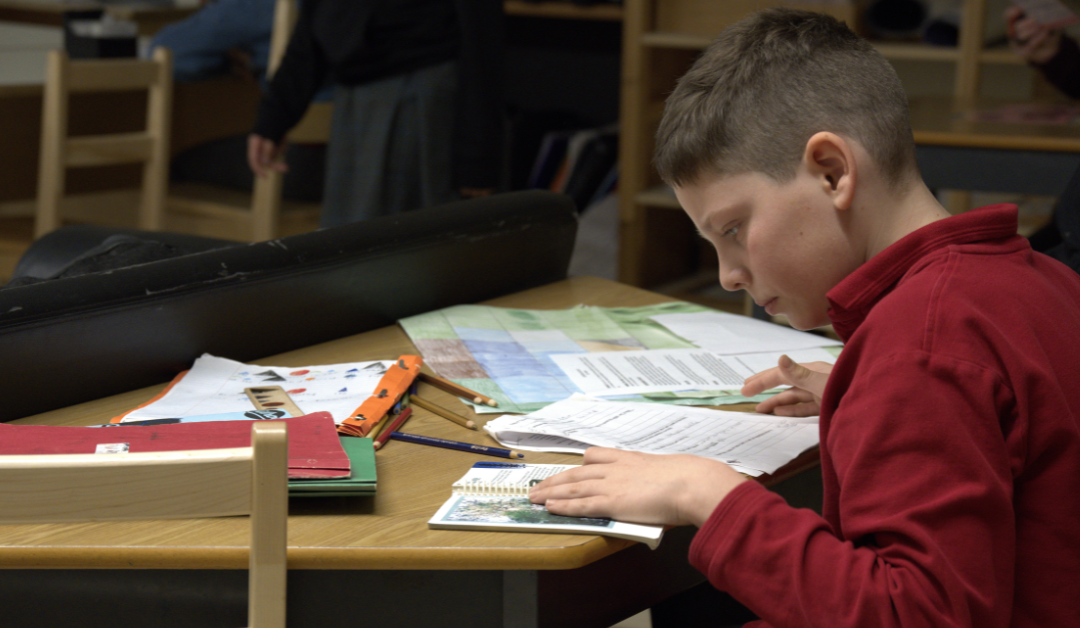
Our Elementary program uses multi-age classrooms where students ages 6 through 12 work at their own paces across subject areas. Teachers present lessons to small groups based on readiness, not age. Students choose materials matching their current skill levels. Older students often mentor younger ones, reinforcing their own understanding while supporting peers.
This approach requires significant teacher skill. Teachers must track where each student is across multiple subject areas, prepare differentiated materials, and provide individual guidance while managing a classroom where students work on varied activities simultaneously. But the outcomes justify the complexity: students develop at their actual rates rather than being held back or pushed beyond readiness by rigid grade-level expectations.
The alternative — teaching identical content to all students in a grade regardless of their varying readiness — inevitably means some students are bored while others are lost. Neither group develops optimally. Individualized pacing serves all students better.
Social-emotional learning as academic foundation, not add-on
Effective elementary schools recognize that social-emotional development and academic learning aren’t separate domains. They’re deeply interconnected, especially for children ages 5 through 11.
Students who can’t regulate their emotions struggle to focus on academic tasks. Students without self-awareness can’t identify when they need help. Social-emotional competencies form the foundation that makes academic learning possible.
Yet many schools treat social-emotional learning as curriculum to be added onto academics — perhaps a weekly lesson on feelings or monthly assembly about kindness. This misses how social-emotional development actually happens.
Children learn emotional regulation through hundreds of daily micro-interactions where adults help them name feelings, identify triggers, and practice calmer responses. They learn collaboration through actual collaborative work requiring negotiation and compromise. They develop empathy through real relationships where others’ feelings matter.
In our Elementary program, social-emotional learning is woven throughout every day. Multi-age classrooms create natural opportunities for older students to practice patience and mentorship. Self-directed work periods require students to assess their own needs, make choices, manage their time, and persist through challenges.
The prepared environment itself supports emotional regulation. Calm, orderly spaces help children organize themselves mentally and emotionally. Predictable routines create security. Freedom within structure allows children to develop self-regulation through practice.
Research consistently shows that students’ social-emotional competencies predict academic achievement as much as or more than cognitive abilities.
Intrinsic motivation versus gold stars: the long-term difference
Perhaps the most significant difference between effective elementary education and conventional approaches lies in how schools motivate students.
Many elementary schools rely heavily on extrinsic motivation: stickers for completed work, charts tracking reading minutes, prizes for good behavior. These systems work short-term. Young children will complete tasks to earn rewards.
But research on motivation reveals serious problems with reward-based approaches for developing long-term learners. When students work primarily for external rewards, they develop external locus of control. They become strategic about maximizing rewards rather than maximizing learning.
Students conditioned to work for gold stars often lose interest in learning for its own sake. Reading becomes filling a chart rather than discovering stories. Mathematics becomes getting correct answers for points rather than solving interesting problems.
Intrinsic motivation — engaging in activities because they’re inherently interesting or meaningful — produces much stronger long-term outcomes. Intrinsically motivated students persist through difficulty because they care about mastery. They explore topics deeply rather than doing minimum requirements.
Elementary schools focused on intrinsic motivation design genuinely engaging learning experiences rather than forcing students through material via rewards. Students choose work that interests them. They experience natural consequences. They receive feedback about actual progress rather than artificial rewards.
In our Elementary classrooms, students select materials based on their interests and readiness. The work itself is interesting enough that external motivators become unnecessary. Satisfaction comes from mastery and accomplishment, building internal standards that transfer to new contexts throughout life.
What to actually look for when you visit an elementary school
Forget the ranking number. When you visit elementary schools, observe and ask about factors that actually matter for children’s development during these crucial years.
Watch how teachers interact with students. Do they speak respectfully to children? Do they kneel to make eye contact at children’s level? Do they seem to know individual students well? Do they provide specific, descriptive feedback rather than generic praise? Strong teacher-student relationships show in these micro-interactions throughout the day.
Observe the learning environment. Is it calm or chaotic? Do students appear engaged in their work or completing it mechanically? Can you see evidence of student choice and self-direction? Does the space feel organized and purposeful? Physical environment powerfully affects children’s ability to focus and learn.
Notice student behavior and interactions. How do students treat each other? Do they seem comfortable asking questions and making mistakes? Do older students support younger ones naturally? Do conflicts get resolved constructively? Social dynamics tell you whether students feel emotionally safe, which determines their willingness to take learning risks.
Ask about class sizes and student-teacher ratios. What are actual class sizes, not district averages? Are there additional adults supporting learning in classrooms? How much individual attention can teachers realistically provide each student daily?
Inquire about individualized pacing. How do teachers accommodate students working at different levels? What happens when students need more time to master concepts? What happens when students are ready for material typically taught at higher grades? Schools committed to serving individual students rather than maintaining rigid grade-level lockstep will have clear answers.
Explore how the school approaches social-emotional development. Is it integrated throughout the day or isolated in special lessons? How do teachers support students’ emotional regulation? How are conflicts between students handled? What language do staff use when discussing students’ social-emotional growth?
Ask about motivation and discipline systems. Does the school use rewards and punishments extensively or focus on developing intrinsic motivation? How do teachers encourage students to engage with challenging work? What happens when students struggle or resist? Responses reveal whether the school views children as needing external control or as capable of developing self-regulation.
Discuss assessment and evaluation. Beyond provincial tests, how does the school assess student learning? Do families receive detailed information about their children’s actual development or just letter grades? Can teachers articulate what individual students are working on and what they’re ready for next?
Pay attention to your child’s reaction. Do they seem comfortable? Interested? Excited? Nervous but intrigued? Your child’s intuitive response to an environment often reveals important information about fit.
How our Elementary program approaches each of these
We’ve designed our Elementary program around principles that research identifies as supporting children’s development during these formative years.
Multi-age classrooms group students across grade spans, normalizing that children develop at different rates and creating opportunities for peer learning and leadership. Our low student-to-teacher ratios allow teachers to know each child deeply, provide individualized support, and build the relationships that help students thrive.
Students engage in self-directed work periods where they choose from carefully prepared materials matching their current developmental levels. This builds decision-making capacity, time management skills, and intrinsic motivation while allowing teachers to work with small groups or individual students.
Our prepared environment extends indoors and outdoors. Students spend significant time in nature on our 143-acre campus backing onto provincial land, experiencing the seasons directly, developing gross motor skills through outdoor play, and learning about natural systems through observation and exploration.
Social-emotional development integrates throughout every day rather than being isolated. Students navigate real conflicts with teacher facilitation learning perspective-taking and repair. Multi-age groupings create natural mentorship opportunities. Collaborative work requires practicing negotiation and cooperation.
We focus on igniting lifelong love of curiosity rather than maximizing test scores. Students learn because the material interests them and because they experience the satisfaction of developing competence, not because they’re collecting rewards or avoiding punishments.
Assessment happens continuously through teacher observation, individual conversations, and work samples rather than relying primarily on tests. Families receive detailed narratives describing what their children are working on, what growth they’re seeing, and what comes next rather than just letter grades.
Our approach prioritizes whole-child development — academic, social, emotional, physical — recognizing that elementary years form foundations for all future learning. We’re preparing students not just for middle school but for becoming confident, capable, curious people who love learning.
The Fraser Institute ranking tells you a number. It doesn’t tell you whether students wake up excited for school. It doesn’t tell you whether they’re developing genuine curiosity or just learning to perform for tests. It doesn’t tell you whether they feel known by their teachers or lost in large classes. It doesn’t tell you whether they’re building intrinsic motivation or dependence on external rewards.
Canadian research on effective elementary education consistently points toward factors that don’t show up in rankings: small class sizes allowing individualized attention, multi-age structures supporting varied pacing, social-emotional integration throughout learning, and focus on intrinsic motivation rather than reward systems.
These factors matter more for children’s long-term development than standardized test scores in single assessment windows. They predict whether students become confident learners who persist through challenges, think critically about complex problems, collaborate effectively with others, and approach learning with genuine interest rather than obligation.
When choosing elementary schools for children in Grades 1 through 6, look beyond the numbers. Visit classrooms. Watch interactions. Ask hard questions about class size, individualized pacing, social-emotional integration, and motivation approaches. Pay attention to your child’s response. Trust what you observe about actual learning environments rather than what rankings claim to measure.
See what effective elementary education actually looks like in practice. Schedule a campus tour at westmontschool.ca to visit our elementary classrooms, meet our teachers, and observe students engaged in meaningful learning across our beautiful campus.
Research Citation:
https://www.buildingbetterschools.ca/smaller_classes_for_everyone